> For the complete documentation index, see [llms.txt](https://chi-protocol.gitbook.io/docs/llms.txt). Markdown versions of documentation pages are available by appending `.md` to page URLs; this page is available as [Markdown](https://chi-protocol.gitbook.io/docs/background/chi-protocol.md).
# Chi Protocol
An Introduction to Chi Protocol, Scalable Stablecoins and Our Mission
## Introduction
Chi is an Ethereum-based protocol issuing a decentralised and capital-efficient stablecoin, known as USC, designed to bring stability, scalability, and sustainable economic incentives to decentralised finance. USC is the first stablecoin issued by Chi Protocol. Liquid Staking Tokens (LSTs) are used as collateral to back it, and it relies on a dual stability mechanism to maintain the price at $1
## Revolutionising the World of Decentralised Stablecoins: An Introduction to USC and CHI
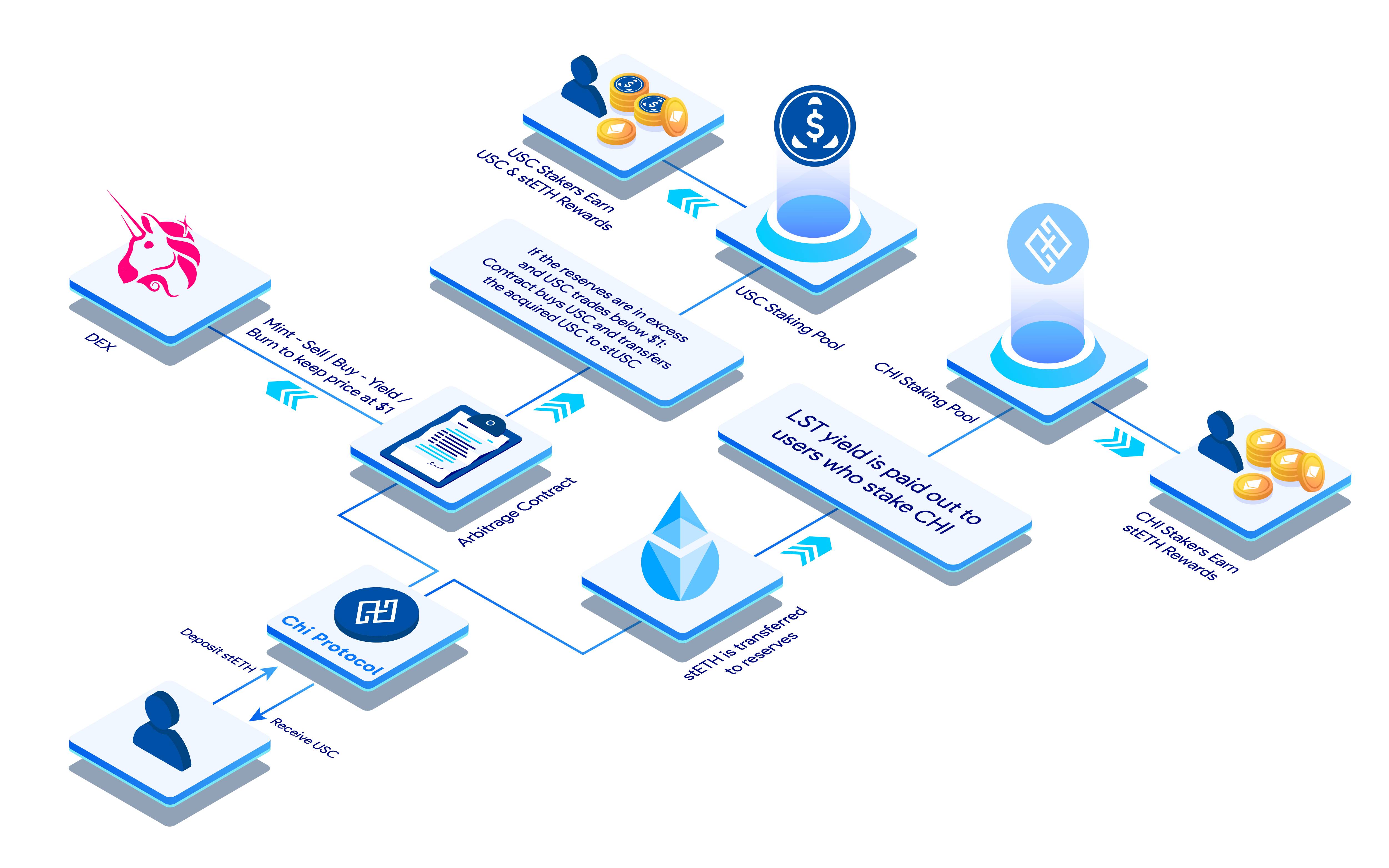
Chi’s primary goal is to scale DeFi with a capital-efficient and yield-generating stablecoin known as USC. This is achieved by always enabling users to mint USC with their LSTs/ETH deposits at a 100% collateral ratio and combining this with the dual stability mechanism to generate a stablecoin yield source for USC stakers.
An additional important component of the Chi Protocol is the CHI governance token, which can be staked to receive the LST yield of the stablecoin reserves. Alternatively, users can lock CHI for a customisable period and have a respective veCHI amount allocated that is used to participate in the governance decisions of the protocol. Moreover, veCHI lockers are entitled to CHI incentives and can earn boosted ETH staking rewards.
USC, a fully backed asset, offers users much-needed stability in the naturally volatile digital asset markets while benefiting from its stable yield component. Meanwhile, CHI allows users to earn native ETH interest and gain from the demand of USC.
## **Aligning Interests of Protocol’s Stakeholders: Innovating Yield Distribution Mechanism of Decentralised Stablecoins**
One unique aspect of Chi Protocol is its opportunity for users to generate a steady income through real yield. Users can earn additional USC from the dual stability mechanism by staking USC. This income is drawn from the case where the stablecoin trades below $1, and the reserves to back it are in excess. In this scenario, the algorithm buys back USC and distributes it to USC stakers. Furthermore, stUSC earns stCHI incentives that automatically earn ETH staking yield.
By depositing ETH or LSTs into the protocol’s reserves, users can mint USC against them. The yield generated from the Liquid Staking Token is distributed to CHI stakers, giving CHI an intrinsic value with a natural source of income paid in ETH.
## Chi, the Holy Grail for Scalability and LSTs
Chi Protocol allows users to use their LSTs or ETH as reserve assets to create USC, a capital-efficient, decentralised, interest-generating stablecoin. Users can deposit either ETH or LSTs and, in turn, mint USC against them, always at a 100% collateral ratio.
If users deposit ETH, it is automatically converted into LSTs through the reserves contract. LSTs inherently generate interest in the reserves, allowing Chi Protocol to distribute earnings to CHI stakers. Simultaneously, USC stakers earn additional USC and stCHI through the dual stability mechanism.
As a result, unlike conventional stablecoins, USC staking generates stable income through stablecoin interest, and USC stakers also earn stCHI, automatically entitling them to the LST yield. This approach effectively harnesses the liquidity potential offered by LSTs and perfectly aligns with the protocol’s interests.
Chi Protocol also enables governance token holders to earn high yields by staking their CHI tokens. The yield comes from the ETH staking rewards generated by the LST reserves. Moreover, CHI token holders can make higher returns than stakers by locking their CHI. This boosts their ETH yields through locked CHI incentives, which automatically earn native ETH staking rewards from the collateral in the reserves.